
From Hemp to High-Value Textiles: University of Alberta Research Advances Sustainable Fibre Innovation
September 22, 2026
Canada’s agricultural resources could play an important role in developing the next generation of sustainable textiles. At the University of Alberta, researchers are exploring how industrial hemp cultivation waste can be transformed into regenerated cellulose fibres with applications ranging from personal protective equipment and healthcare products to nonwovens and consumer apparel.
Through the Regenerated Cellulose Textiles from Hemp project, the research team has been working to determine the optimal processing conditions for producing Lyocell regenerated cellulose fibre from hemp. The goal is to better understand how Canadian-grown hemp can serve as a viable feedstock for high-value textile products while helping create new opportunities across Canada’s agriculture, biotechnology and manufacturing sectors.
Lyocell is a more environmentally friendly process to produce regenerated cellulose fibre than viscose. Hemp offers a particularly interesting Canadian feedstock opportunity thanks to its high cellulose content. While Canada has an established industrial hemp sector, finding higher-value uses for hemp fibre and agricultural biomass could create additional markets for producers while supporting the development of more sustainable domestic materials.
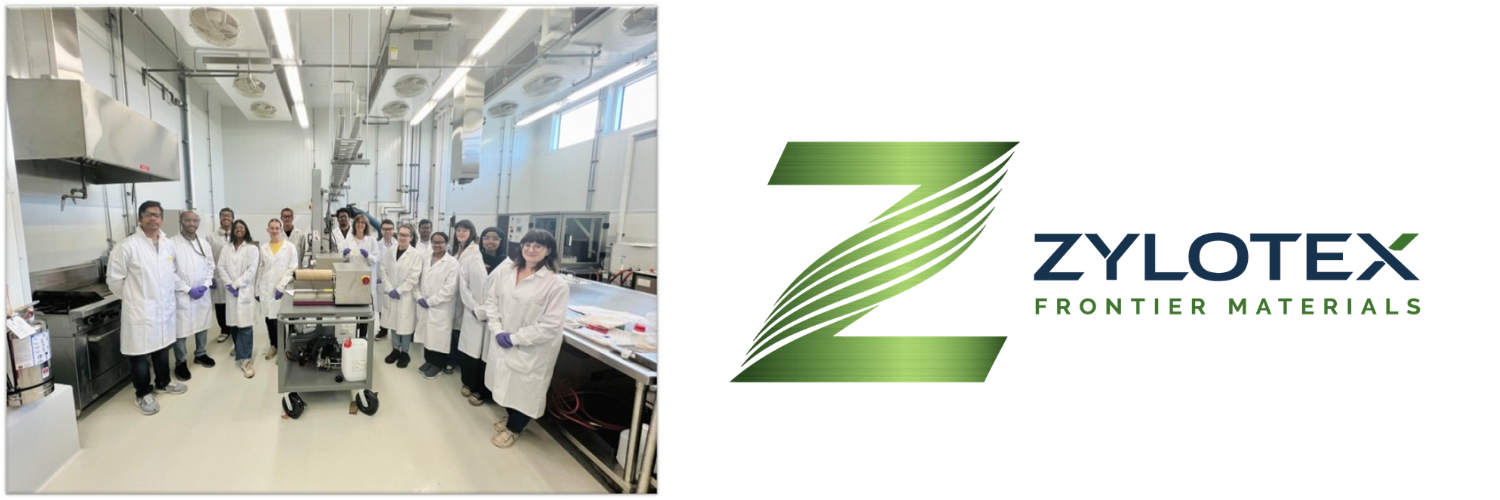
Led by Dr. Patricia Dolez, Principal Investigator at the University of Alberta, the project is now moving toward its final stages and has progressed beyond evaluating the concept. The team has produced metres of fibre using a prototyping spinning line, demonstrating the potential to transform hemp-derived cellulose into regenerated fibres and providing an important foundation for further product development and scale-up.
“The progress observed in just over three years has been impressive; thanks to the ‘hempions’ team, we have paved the way for the production of made-in-Canada technical cellulosic fibre from local feedstock,” said Dr. Dolez.
Just as importantly, the research is beginning to connect with commercialization opportunities.
Alberta-based start-up Zylotex Inc. is an industry partner working with the University of Alberta to develop and commercialize hemp-derived pulp and regenerated cellulose fibre technologies. The company is focused on manufacturing sustainable pulp and Lyocell fibre from Canadian hemp feedstocks, creating a potential pathway for research and technical expertise developed in Alberta to move toward commercial applications.
“Canada imports a lot of the products and materials we use every day, but why shouldn’t we make more high-value materials here too?” said Lelia Lawson, CTO of Zylotex. “This research, focused on an agricultural crop that already grows here, has helped take that idea from ‘what if?’ to something tangible. Now Zylotex is working to take the next step: scale it, get it into customers’ hands, and ultimately manufacture it here in Canada.”
The collaboration between the University of Alberta and Zylotex illustrates how academic research and industry expertise can work together to advance new materials. Moving a new material from laboratory research to the marketplace requires not only strong science, but also industry partners capable of evaluating applications, developing products, establishing supply chains and ultimately scaling production.
For Canada, that opportunity extends beyond textiles themselves. Developing technologies capable of transforming domestically produced biomass into higher-value materials can help strengthen Canadian manufacturing, create new markets for agricultural resources and reduce reliance on imported textile fibres and products.
There is also significant potential in the range of applications being explored. Hemp-derived Lyocell could ultimately be used in products including protective clothing and personal protective equipment (PPE), dental floss, healthcare materials, nonwoven products and consumer textiles, opening multiple potential markets for the technology.
With laboratory development underway and a connection to an Alberta company pursuing commercialization, the project represents a promising step toward building a Canadian value chain that connects agriculture, research, advanced materials and manufacturing.
As the research moves through its final stages, the next challenge will be translating these technical advances into scalable products and commercial opportunities—helping demonstrate how Canadian biomass, Canadian research and Canadian entrepreneurship can come together to create the materials of the future.
Q&A with the University of Alberta Research Team
What has the project achieved so far?
We have produced metres of smooth, continuous fibre from hemp feedstock. We have also determined pathways to functionalize the fibre so that it offers flame-resistant properties.
What has the research learned about hemp and its suitability for Lyocell production?
We have confirmed the high cellulose content of several hemp varieties produced in Canada. We also developed a simplified, more environmentally friendly pulping process to convert hemp feedstock into a dissolving pulp adapted to the Lyocell process.
What has been the most significant technical milestone?
A very special moment was producing the first made-in-Canada Lyocell fibre from hemp. Another turning point was moving from lab-scale production with a microreactor to our prototyping spinning line.
How does Zylotex connect to the project?
Zylotex contributes to the project by supporting research and technology development as part of its broader work to commercialize hemp-derived pulp and regenerated cellulose fibres. Zylotex CTO Lelia Lawson recently completed her PhD at the University of Alberta, where her research focused on the Lyocell project.
Where is the technology now on the commercialization pathway?
We have demonstrated proof of concept at the lab scale and are now finalizing the optimization of manufacturing parameters at the prototyping scale.
What happens next?
The next step is for Zylotex to establish a pilot production line.
Why hemp? What advantages does it offer over conventional cellulose sources?
Hemp has a much higher cellulose content than traditional Lyocell feedstocks such as wood, which allows us to reduce the use of chemicals in the pulping process. In addition, hemp grows very quickly and generates large amounts of biomass, which can help limit the risk of deforestation. Another advantage is the opportunity for whole-plant utilization after the grain has been harvested.
What opportunity could this create for Canada?
This work creates an opportunity to add value to Canadian-grown hemp by developing a higher-value market for fibre and biomass remaining after grain harvest. Longer term, it could support a domestic value chain connecting Canadian growers with pulp, fibre and textile manufacturing, while creating new manufacturing opportunities and reducing reliance on imported cellulose-based textile materials.
About the Bioproducts AgSci Research Cluster Initiative
The Bioproducts AgSci Research Cluster initiative is managed by Bioindustrial Innovation Canada (BIC). This initiative is a nationally distributed pre-commercial research cluster focused on the development of industrial bioproducts technologies and their feedstocks from the Canadian agriculture sector, supported by Agriculture and Agri-Food Canada. Funding is provided through the Sustainable Canadian Agricultural Partnership.
